
Frederick County Former Owner Sources
Tracing the former owners of a Frederick County property means working backward through the deed records one grantor and grantee at a time. The newest deed names the current parties. Older deeds show who conveyed the parcel before them. Where the online index stops, deed books, plats, and probate files at the courthouse carry the story further. Anyone who wants to search Frederick County property records by address should remember one thing. Street names change over the years. Legal descriptions and parcel numbers do not. Those details, not the address alone, unlock the earlier chain.
| Source | Years It Covers | Where Held | What It Shows |
|---|---|---|---|
| Current land-record index | Online cutoff not located | Frederick clerk and Virginia SRA | Recorded parties and instruments within the available index |
| Older deed books and indexes | Colonial-era to present as a record series; exact volumes to verify | Circuit Court clerk, Library of Virginia or microfilm | Earlier conveyances and the names needed to extend a chain |
| Recorded plats | Exact book and year run not located | Circuit Court clerk; GIS or planning cross-reference | Subdivision lots, lot splits, easements and legal descriptions |
| Historic tax and assessment rolls | Exact years not located | Commissioner, Treasurer or archive by request | Context for an owner or parcel in a given period |
Find the newest deed matching the parcel first. From there, walk the grantor-grantee index backward. When the online property search stops returning results, ask the clerk which deed-book index covers the earlier years, and check the Library of Virginia catalog for microfilm or archival collections. A tax list or city directory can suggest a name. Only the land instrument proves the title.
Frederick County Deed Book Cutoff
The Frederick clerk publishes no stated earliest year for its online deed index. The statewide SRA landing page does not always display its search fields. Local coverage varies. Before chasing a long chain, ask the clerk where the remote index ends. Ask which grantor-grantee books cover the earlier period too. A name missing from an unverified online date range is not proof. It does not show that no transfer was recorded.
The local Circuit Court clerk website is the county-specific service entry point. 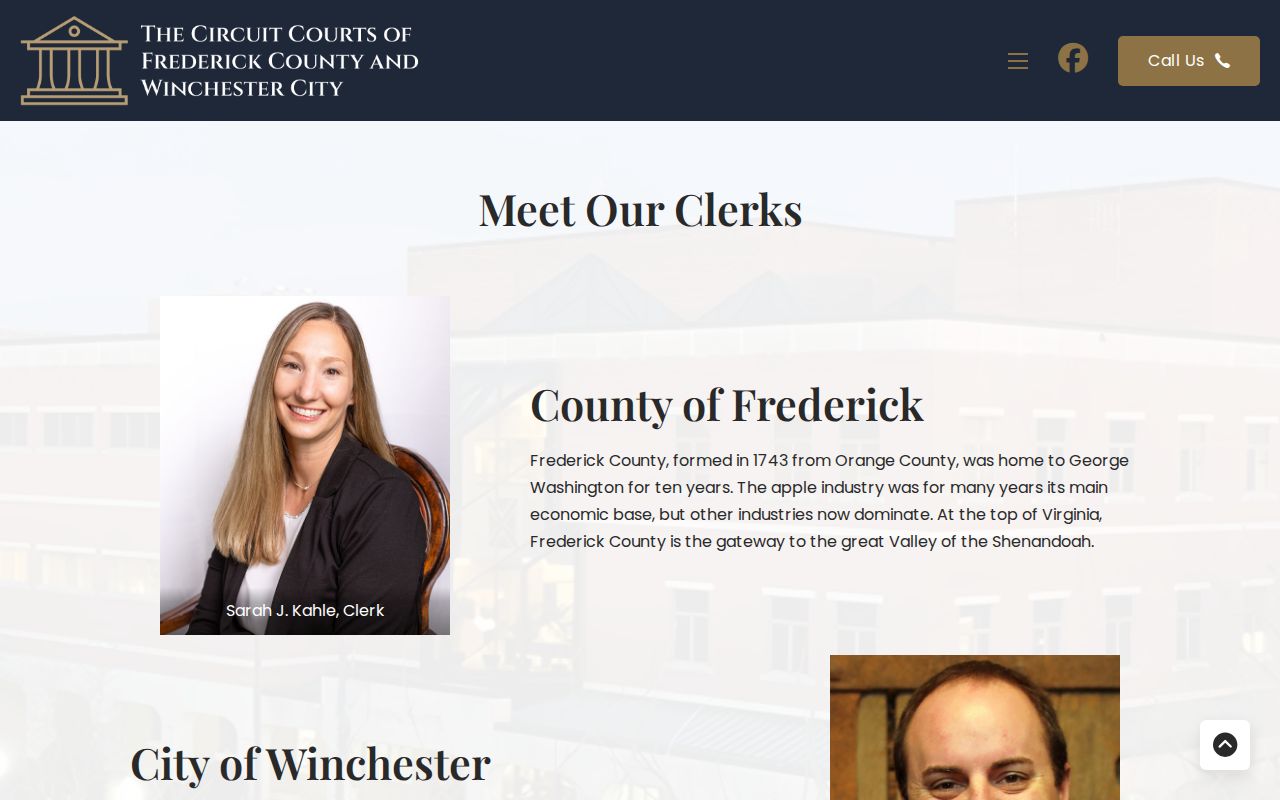 The clerk can direct a searcher from the newest online deed toward an older volume, index or copy request.
Separate Transfers from Later Recorded Notices
Not every item in the land-record index changes the owner. A deed conveys an interest. A deed of trust records a security interest. A release shows an obligation was satisfied. A plat lays out or revises mapped lots. Judgments and estate instruments add context of their own. Classify each result before placing it in the chain, so a financing or mapping record never masquerades as a transfer.
For every conveyance, note the recording reference, grantor, grantee, instrument date, and legal description. Then follow each grantee backward as the next grantor, confirming the earlier deed describes the same land. If the chain crosses a probate transfer, check the will or fiduciary record the Circuit Court Clerk holds, and look for an executor or administrator deed. That discipline keeps a parcel-specific chronology intact even when names repeat or lots are described differently across the deed records.
Virginia Archives and Frederick Deeds
Frederick County formed in 1738. Its land trail runs deep. The exact surviving run of deed books is not cataloged, though. Ask the clerk for the book and index. It should cover your target year. Then search the Library of Virginia catalog for county land-record groups and microfilm. FamilySearch works as a secondary lead only. That holds when its catalog names the relevant official collection.
Directories, census pages, and tax lists help tie a family or address to a period. They prove no conveyance. Record the clue. Then return to a deed or plat with the matching legal description. A chain is only as strong as the parcel match behind each name.
Walk the Frederick County Deed Chain
Build the chain by following each deed's grantee back to the prior grantor. At every step, compare the parcel description, instrument date, and recording reference. A same-name owner can pull the property search onto a false track. A neighboring lot can do the same. The clerk's SRA field list and online cutoff are not published. When a link ends, the clerk can point you to the right older index.
- Find the newest deed and note the current grantee, legal description and recording reference.
- Read the grantor named in that deed and search that party as a grantee in the earlier index.
- Check that the earlier deed describes the same land, including any lot or plat reference.
- Repeat until the online result stops, then ask for the corresponding deed-book index or microfilm.
- Grantor
- The party who conveyed the interest in a deed.
- Grantee
- The party who received the interest described in that deed.
- Chain of title
- The sequence of recorded conveyances affecting the parcel.
- Legal description
- The description of the land conveyed; it remains useful when a street address changes.
Winchester Annexations and Past Owners
An old deed or directory may place land in Frederick County. The parcel may now sit inside Winchester, though. The city annexed land in 1921. It expanded by nearly six square miles in 1971. Those dates are handy tests. Use them when an address line and the current tax bill seem to disagree. The shared courthouse never merged the city and county property rolls.
Use the present parcel polygon for current jurisdiction. Keep the historic wording when searching older records, though. Street names, numbers, and postal cities change. The legal description keeps identifying the same land. County GIS address-change reports can bridge an old address to the current one.
Probate Routes for Frederick County Estates
Death often sits behind a sudden change in ownership. A former owner who died may be followed by an heir, a surviving co-owner, or a trust. A court-appointed fiduciary can also step in. The Circuit Court clerk keeps the wills and probate inventories. The clerk also holds fiduciary appointments for Frederick County estates. An executor or administrator deed can document the transfer that follows. Read the probate file and the land index side by side. Compare parcel descriptions and names as you go. That comparison explains the odd jump. A deed can pass from a decedent to a fiduciary or heir instead of a familiar buyer.
Some probate details stay sealed or redacted. The clerk can explain how to inspect older files and what copy rules apply. For today's tax-roll name, run the Frederick County owner-of-record check as a separate present-day step.
Virginia Genealogy for Property History
Vital records can anchor a property history in dates. A death, marriage, or birth record may pin down when a past owner's claim began or ended. Virginia's Department of Health publishes birth and death indexes from 1912 onward, marriage indexes from 1936, and divorce indexes from 1918. Statutory opening periods still apply. Under Virginia Code section 32.1-271, birth records generally open after 100 years and other covered events after 25 years, subject to exceptions. Restricted copies carry their own eligibility and identification rules.
The VDH genealogy page describes Library of Virginia microfilm for surviving Virginia birth and death records from 1853 to 1896 and marriage records before 1936. See the official genealogy and microfilm information. 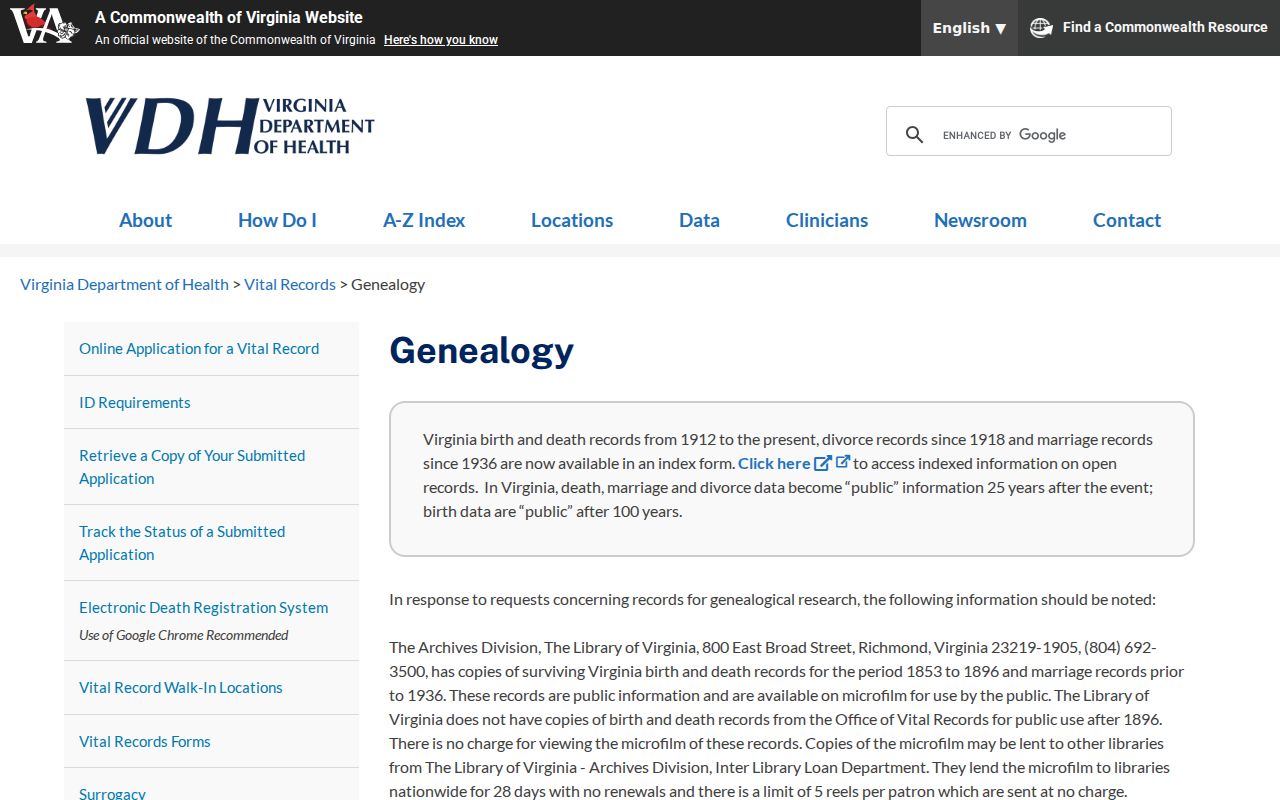 These sources add family chronology; a recorded deed still proves the land transfer.
How Far Back Frederick County Owners Go
Frederick County dates to 1738. That year alone tells you little about what you can search from home. It does not fix the online index range. Nor does it prove every deed book survived in one place. The clerk publishes no confirmed cutoff for remote indexing or imaging. So ask directly about earlier bound indexes and deed books. Begin with the current online index. The Library of Virginia's catalog and microfilm can then extend the search. Just identify the exact locality record group first.
Lawful use. Former-owner research can support house history, an estate matter or property diligence. Do not use old addresses or names to track, harass, threaten or harm a living person.