
What Each Frederick County Property Value Means
Frederick County property values come from assessment records kept by the Commissioner of Revenue. Those figures drive local taxation. They also give owners and neighbors a shared public reference. That reference covers land and improvements across the County. An assessed value is not a promise of what a house will sell for, though. Mixing the two up leads people astray. To look up a Frederick County property value, start with the parcel's address or tax-map reference. Then read the assessment for its stated year. A search Frederick County property records by address works well when the parcel number is unknown. Comparing the assessment with recorded deed information adds useful transaction context whenever a number truly matters.
| Value | What It Is | Where |
|---|---|---|
| Assessed value | County's taxable estimate for the stated assessment year | Commissioner of Revenue property card |
| Fair market value estimate | Full-value estimate used as the basis of assessment | Commissioner of Revenue |
| Sale consideration | Amount reported in a particular recorded conveyance | Circuit Court Clerk deed record |
| Land and improvements | Separate components of an assessment, when displayed on a card | Property card; exact live fields not confirmed |
Virginia localities lean on the assessed value as the taxable base. Frederick County's stated standard is full fair market value. Even so, the assessment is not a broker's opinion. It is not a lender's appraisal or the next negotiated price either. The property card may not display every field the same way each year. Open the live record rather than assuming a particular land and building breakdown or sales history is present.
Look Up a Frederick County Assessment
The Commissioner of Revenue maintains an online property-card access page for the County. Start there. Search with whatever identifying information you hold. An address or owner of record name works. The access page opens with a disclaimer. An older route once displayed a notice saying the original link was no longer valid. It directed visitors to a newer service. That notice is not an assessment result. Never read it as evidence that a parcel's card is empty. Never read it as evidence that its value is zero.
- Open the Commissioner of Revenue property-card page and follow its current link into the card search.
- Search by the available parcel or address information. If the portal does not accept a street-address format, use the County GIS map to identify the tax-map reference and retry.
- Record the assessment year and the value as displayed. Do not infer an unshown field from a prior card, a map, or a third-party listing.
- For transaction context, find the latest deed through the Circuit Court Clerk or Virginia SRA and compare the recorded transfer date and consideration with the assessment year.
- Assessed value
- The value assigned to the parcel for the local real-estate tax roll.
- Fair market value
- The County's estimate of the price a property would bring under ordinary market conditions; it is not the price a future buyer must pay.
- Appraised value
- An opinion prepared for a particular purpose by an appraiser, often with a property inspection and defined effective date.
Assessment Is Not a Sale Appraisal
Frederick County's assessment program values real estate for taxation across the whole County. Every property is valued on a shared schedule. It is not a custom appraisal. A single sale, refinance, estate question, or insurance claim calls for a different kind of valuation. Recent transfers may not show up in an assessed figure right away. Physical changes and fast-moving markets may lag too. The number still serves two purposes well. It helps with understanding the tax roll and raising a valuation question with the County. No buyer, lender, or court is obligated to accept it for some other purpose.
Value versus price. A County assessment is not a prediction of what a property will sell for. For a transaction or lending decision, ask a qualified appraiser to prepare an opinion for that purpose.
Frederick County's Two-Year Assessment Cycle
Frederick County reassesses real estate every two years. That schedule matters as much as the dollar amount. A value in effect for one tax cycle may lag behind improvements. It may also lag behind a change in condition or market movement since its effective date. The 100% fair-market-value standard describes the intended level of assessment. The two-year cycle describes when the roll gets reviewed and updated.
Compare properties from the same assessment cycle. Weigh land use, acreage, access, dwelling characteristics, and neighborhood location before drawing any conclusion. Two different assessed totals do not prove unequal treatment. The underlying parcels and improvements may simply differ. If a card seems to omit an improvement or lists a wrong characteristic, gather the parcel number and supporting documents first. Then ask the Real Estate Division to review it.
What the Public Card Access Page Tells You
The Frederick County online service begins at a Commissioner of Revenue disclaimer page. It warns that data may be inaccurate. The County does not warrant the completeness of its values. Displayed account balances may not include payments or adjustments still in transit, the page notes. It also states that Social Security numbers are confidential under Virginia Code §§58.1-3 and 58.1-3017. Treat the card service as a strong starting point. Verify before relying on any single figure.
An older card link showed no parcel card and listed no search fields. Its message said the original link was no longer valid. It pointed toward a replacement route. Use the current County page and follow its own instructions. If the link has changed again, contact the Real Estate Division. Do not enter personal details on an unrelated page: Frederick County property-card access and disclaimer.
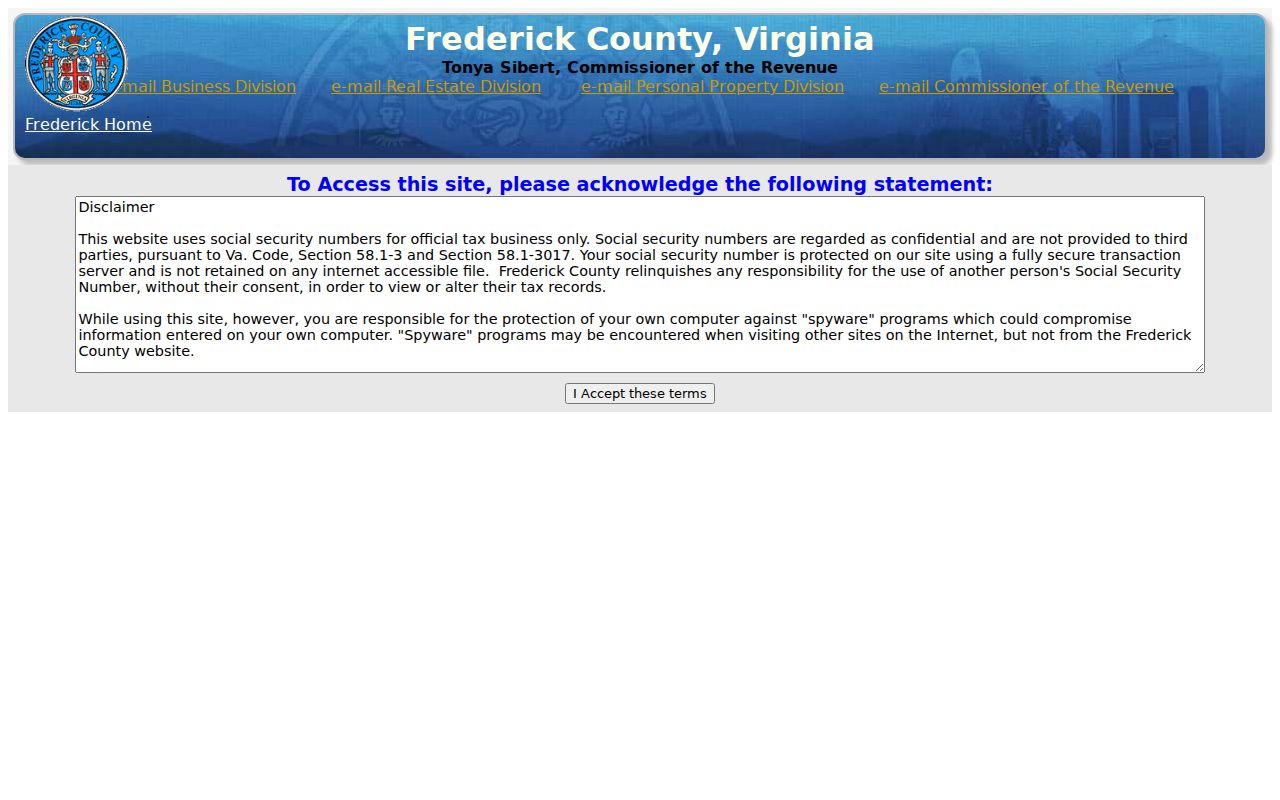
The image shows the County's disclaimer gate rather than the fields or values a parcel card returns.
Compare the Assessment with a Recorded Transfer
A deed helps place an assessment in context, but the two numbers answer different questions. The deed records a transfer between grantor and grantee. It may state consideration. An assessment, by contrast, is the County's valuation for the tax roll. It applies as of its own effective date. A transfer between relatives may not reflect the market at all. The same goes for a corrective instrument, an estate distribution, or a deal with unusual terms. Before relying on any comparison, check the instrument date and the property description. That way the deed concerns the same parcel.
The Circuit Court Clerk maintains deeds and deeds of trust at the Joint Judicial Center. Statewide land-record access runs through the SRA. Online coverage, cutoff dates, and copy charges vary. Consult the Clerk when a specific instrument is not available online. The Frederick County deed-records guide walks through the index and verification steps in more detail.
Town, City, and Overlay Context for Values
Property in Stephens City or Middletown stays on the Frederick County assessment roll. A town may still impose its own local tax or zoning requirements. A ZIP code alone cannot settle the question. Winchester is different. As an independent city, it sits outside County assessment and land-record custody. A Winchester address therefore belongs with city offices rather than the Frederick County roll.
For Winchester properties, historic-district or neighborhood-development overlays may shape renovation review or incentives. An overlay never states market value on its own. The County's GIS layers can clarify boundaries and planning context. Verify valuation and taxing jurisdiction with the responsible assessor. Use the parcel map guide to orient a parcel. Then confirm value with the correct office.
Prepare a Focused Valuation Question
A disputed Frederick County assessment starts with the basics. Confirm the right parcel and the right assessment year. Review the property characteristics on the card. Gather photographs, permits, comparable sales, or other supporting information. Then contact the County Commissioner of Revenue for current review and appeal instructions. The County's appeal form asks for the owner, tax-map number, site and mailing addresses, land, building and total values, and the owner's opinion of value. The form is only a starting point. Confirm deadlines and filing requirements with the office, since procedures can change.
For how an assessment relates to the amount due, see the separate property-tax-records page. Keeping valuation and tax-bill questions apart helps route a request to the correct County function.