
Frederick County Deed Records and Instruments
Every instrument adds a link in the chain. The Frederick County Circuit Court clerk keeps deeds, deeds of trust, releases, plats, easements, and judgments among the land records. The name of an instrument is only a label. Read the parties, the date, the legal description, and any later filings to learn what the paper actually does. The grantor conveys an interest; the grantee receives it.
| Deed Type | What It Does | Common Use |
|---|---|---|
| Warranty deed | Conveys the interest described and includes stated title covenants | Review the deed language and legal description for a transfer |
| Quitclaim deed | Conveys whatever interest the grantor has, without a warranty of title | Compare the parties and property description with earlier instruments |
| Executor or administrator deed | Transfers estate property through a fiduciary | Check probate authority and the recorded instrument |
| Deed of trust | Creates a recorded security interest in real property | Look for a later release or certificate of satisfaction |
| Release or easement instrument | Releases an encumbrance or states a land-use right | Read the legal description and any later amendment |
A deed of trust does not convey ownership. It secures a loan against the land. A later release or certificate of satisfaction clears that security instrument from the record. An easement is different again. It grants another party a defined use of the land, while the clerk's index simply lists instruments without certifying that every title question is resolved.
Frederick County SRA Search Limits
Virginia Secure Remote Access is the statewide remote route for land records. The local clerk site links web records as well. Coverage details are best confirmed firsthand. The county-specific cutoff, grantor and grantee fields, document-type options, date range, image gate, and result limit are the kinds of details the live portal shows directly. Open the portal before trusting a search field. Or ask the clerk whether a given year of deeds is covered.
| Search detail | What the research confirms | Next check |
|---|---|---|
| Local custodian | Frederick County Clerk of the Circuit Court | Confirm local index coverage and copy rules |
| Remote system | Virginia SRA serves participating circuit clerks | Inspect visible fields and locality selection |
| Oldest online year | Not located in official sources | Ask the clerk for the online cutoff and book range |
Frederick County Deed Books and Microfilm
Frederick County was formed in 1738. Its land history reaches far past modern online images. That span makes older deed research part patience and part paper trail. Start with the clerk's current index and write down the oldest year it returns. Then ask about the older grantor-grantee books. The Library of Virginia catalog can identify county record groups and microfilm, and FamilySearch helps only when its catalog names the specific collection.
Older name indexes have traps. Roads get renamed, parcels split, and parties change names. The legal description and plat reference separate same-name entries when the index alone cannot. For a long chain of title, work the name trail backward and use recorded plats to sort out lot splits. The adjoining former-owner trail focuses on that exact time sequence.
Frederick County Grantor Grantee Index
The Frederick land-record path runs through the Clerk of the Circuit Court and Virginia SRA. The online index has limits. The county's online date range, document-type menus, address filters, image fees, and earliest year should all be confirmed with the clerk rather than assumed. A missing result is not proof. A deed may sit in an older book that the online index does not reach. Ask the clerk before concluding no deed exists.
- Start with the current grantee name from a confirmed assessment card or deed.
- Find the recorded instrument and compare its legal description with the parcel.
- Read the grantor on that deed; search the grantor as a grantee in the earlier index.
- Repeat the name-to-name trail and note each date and instrument reference.
- When online results stop, ask the clerk for the older deed books and indexes.
- Grantor
- The party conveying the interest described in a recorded instrument.
- Grantee
- The party receiving the interest in that conveyance.
- Chain of title
- The sequence of recorded conveyances and other instruments affecting a parcel.
- Book and page
- A bound-volume reference; confirm which references the Frederick clerk uses for the record at hand.
- Instrument number
- A document identifier in an electronic recording system; exact Frederick SRA display fields were not verified.
Frederick County Deeds of Trust and Releases
The Circuit Court clerk records more than transfers. A deed of trust secures a loan against land. Its later release or certificate of satisfaction shows the security interest was cleared. Easements and covenants can be recorded alongside a deed or plat. Index labels are not the whole story. An instrument may affect only part of a parcel or benefit a neighboring lot, so read the legal description and named parties rather than the label alone.
Mechanics' liens, judgment liens, and lis pendens appear in land records and court files. A lis pendens signals pending litigation tied to property. The docket and final order explain the case. UCC fixture filings run through the Virginia SCC system instead of the land index. The two record trails answer different questions, and neither substitutes for the other.
Related Circuit Court Instruments
The Frederick County Clerk's land-record collection runs wider than purchase deeds. It also holds deeds of trust, releases, plats, and judgments. The Circuit Court office handles wills, probate, and marriage licenses. Each instrument plays a distinct role. A deed of trust secures an obligation. Its later release records satisfaction of that lien, and neither paper substitutes for the deed that actually conveys ownership.
Context often hides in these files. A judgment can cloud title. A recorded plat can reshape how a parcel is researched, and a probate file explains an executor's authority to convey estate land. Names can mislead as well. When the index shows a party name without an address match, the tax-map reference or the recorded plat can separate the intended property from a similarly named parcel.
Online access has edges. Some instruments sit past them. When a referenced instrument cannot be reached online, contact the Clerk and ask whether it lives in an older book, a separate index, or an image series. That question usually resolves the hunt quickly.
Tax Sale Notice and Recorded Deed
A delinquent-tax notice is a signal, not a transfer. Ownership changes only when a deed is recorded. Frederick County posts a Tax Sale Information Center. The Treasurer's current notice, calendar, bidder rules and redemption terms belong there rather than in any secondhand summary. Read the Treasurer's material directly. Then pull any Circuit Court file on the property.
A docket entry is not the complete court file. A tax-sale list does not prove a parcel actually sold. Notices get withdrawn, paid, or replaced by a later action. The recorded deed and its legal description are the transfer evidence that holds up in Frederick County property records. Confirm the transfer through the clerk's recorded deed index before relying on anything else. Close out by checking the tax account with the Treasurer. The parcel's status should match the deed record.
Getting a Frederick County Deed Copy
Begin with the clerk's land-record page or SRA to locate the instrument. The local clerk's office is at the Joint Judicial Center, 5 N. Kent Street, Winchester, VA 22601, telephone (540) 667-5770, and published hours are 8:00 a.m. to 4:00 p.m. If the online image is unavailable or the record is older, ask the clerk how to request a plain or certified copy by mail or at the counter. Current copy and certification charges were not confirmed in the research.
The screenshot links to the Frederick County and Winchester clerk's website. It is the local entry point for available services; the statewide Virginia SRA land-record system may cover participating localities, but coverage and result fields vary.
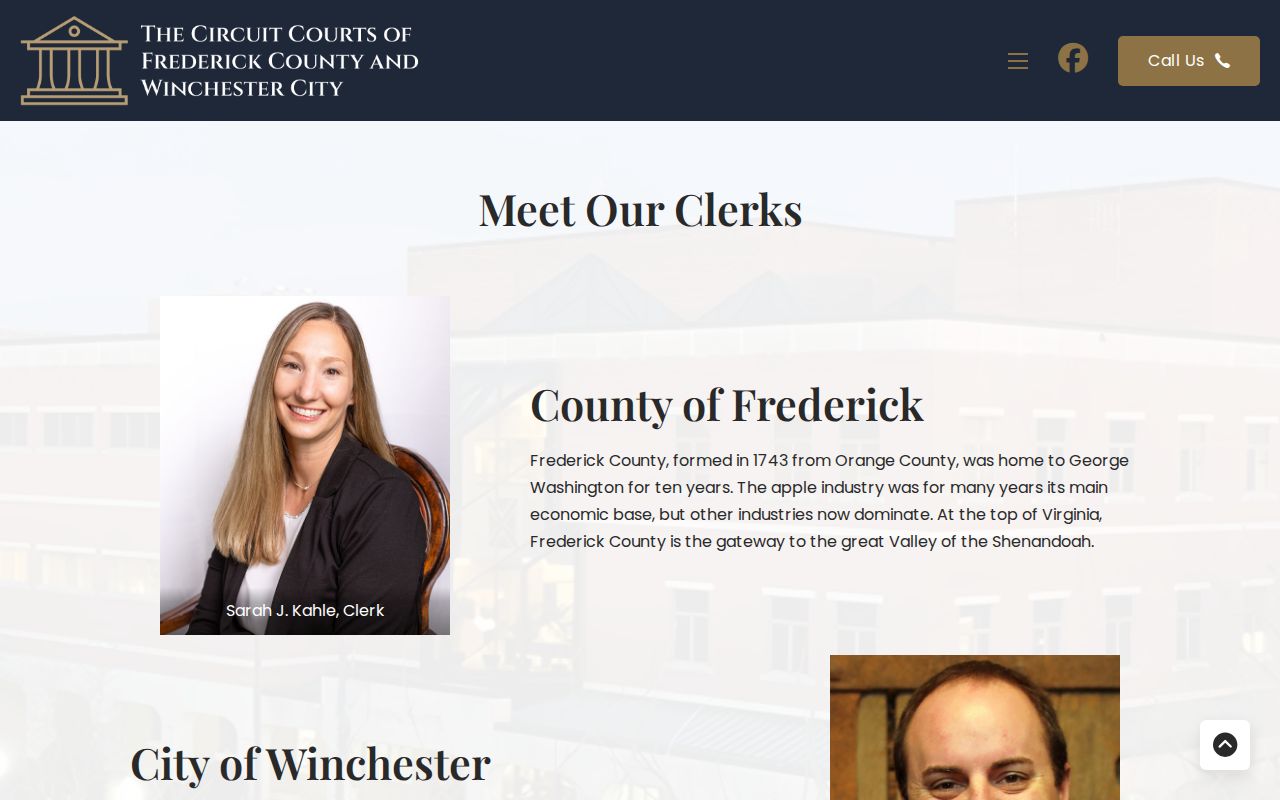 Use the local clerk for Frederick-specific access questions and certified-copy instructions.
Recorded, not guaranteed. An index result shows an instrument recorded in the system, not a complete title opinion. Unrecorded interests, indexing errors or missing older material may affect the chain, so confirm important questions with the custodian and a qualified title professional.
Estate Deeds in Frederick County
A will alone rarely settles a land transfer. Probate appointment papers do not either. When property passes after an owner's death, the Frederick County Circuit Court clerk keeps the wills, probate inventories and fiduciary filings that shape the estate. An executor or administrator deed may record the conveyance. Pair the probate file with the land-record index. Then confirm the legal description matches the parcel in the deed records.
Virginia vital records follow separate access rules. The Department of Health holds current certificates, while older public periods and Library of Virginia microfilm can pin down dates for historical work. A death record builds the timeline. It proves nothing about title. The clerk's recorded deed remains the land instrument to check, and probate materials may carry their own access or copy limits.